There is no wrapped XMR or ZEC on Ethereum, so a DEX cannot deliver either coin — you need a route that hands off to the Monero or Zcash network itself. Four routes can do it, and they differ in steps, rate type and what happens if screening declines your swap. The table and 7-point checklist below compare them.
Fswap swaps 4,300+ crypto pairs without an account, including direct ETH to XMR, SOL to XMR and ETH to ZEC pairs.
Monero and Zcash have no wrapped version and no liquidity pool on EVM chains, so a DEX-plus-bridge route cannot reach them at all.
The Monero network packages transactions into blocks every 2 minutes on average (Monero Project, getmonero.org, 2026).
Zcash cut its block target spacing from 75 seconds to 25 seconds with the NU7 upgrade, activated on mainnet at block 3,543,405 (ZIP 218, zips.z.cash; activation reported November 6, 2026).
A fixed rate locks the amount you receive for a short window; a floating rate follows the market until the swap executes. The choice matters more on slow source chains.
If screening declines a swap, the outcome depends on the route: some providers hold funds pending review, while Fswap Private Mode refunds them to the sending address.
You need a route that ends with a payout on the Monero network itself. Ethereum cannot hold XMR, and no credible wrapped version of it exists, so there is nothing for a DEX to swap into.
This is the structural difference between Monero or Zcash and almost every other asset you can reach from Ethereum. A bridge works by locking an asset on one chain and minting a representation of it on another. Monero's design does not produce an asset that can be represented that way, and Zcash shielded value cannot be wrapped either.
So the route has to be an exchange, not a swap contract: something receives your ETH, USDT or SOL, and sends XMR or ZEC from its own Monero or Zcash wallet to an address you control. That handoff is what every working route below has in common — they differ in who performs it and what you give up for it.
Four routes can take an EVM-chain or Solana asset to XMR or ZEC. One of them cannot actually complete the trip, and it is worth knowing why before you try it.
Route | How it reaches XMR / ZEC | Rate | Account | If screening declines the swap |
|---|---|---|---|---|
Deposit-based exchange route — e.g. Fswap | One-time deposit address, exchange, payout straight to your XMR or ZEC address | Fixed or floating | Not required | In Private Mode, funds are refunded to the sending address |
Cross-chain and privacy aggregator — Rubic | Compares the available private routes for your pair, then passes the swap to the provider you choose | Set by the chosen provider | Not required | Set by the chosen provider |
DEX plus bridge | Cannot complete: no wrapped XMR or ZEC and no pool to route through | — | Not required | — |
Centralized exchange withdrawal | Trade on the order book, then withdraw to your own XMR or ZEC address | Order book | Account and identity verification | Funds are typically held pending review |
Routes are ordered by how many steps separate an EVM-chain asset from XMR or ZEC in your own wallet — fewest steps first. Delisting is the other thing to watch on the last row: several large platforms have dropped XMR support, so a route that worked last year may not exist on your account today.
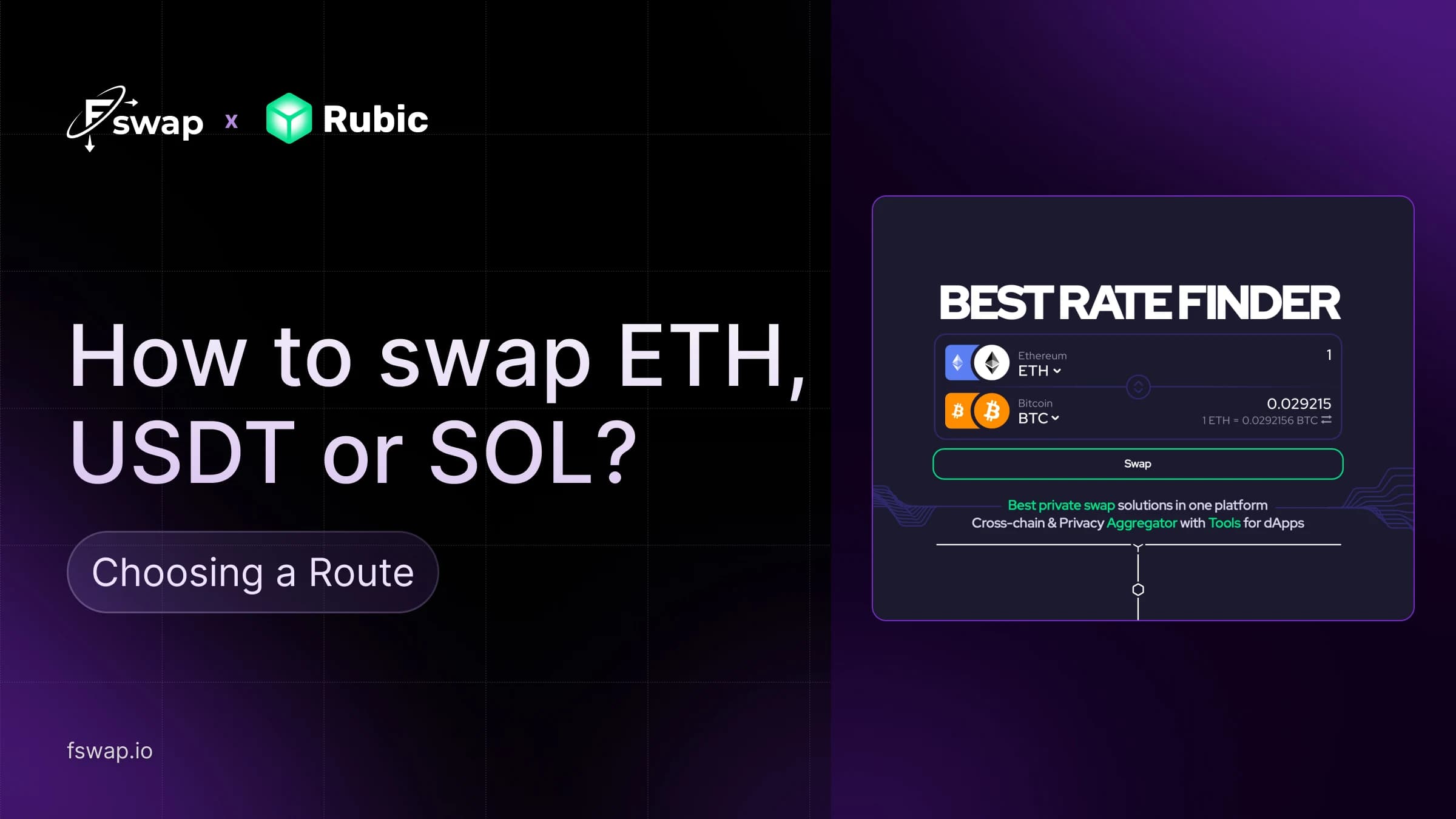
Rubic — cross-chain and privacy aggregator across 70+ chains, incl. Monero and Zcash. It features Private Mode for privacy chains, as well as for EVM networks, BTC, XRP, etc. It is useful here because it does the comparison step for you: it reads the available routes across chains for the pair you want, including Fswap's, and shows you fees and expected speed side by side rather than asking you to open five tabs. Rubic covers 70+ chains and 70,000+ tokens across 340+ DEXs, bridges, intent protocols and privacy solutions (Rubic, November 2026), and Fswap is now one of the routes you can compare there. Rubic Private Mode providers are Houdini, RocketX and ClearSwap, with more to come.
Pick the aggregator when you want to see what the market offers for your specific pair and amount. Pick a single exchange route directly when you already know the pair is supported and want one fewer intermediary between you and the payout.
A fixed rate locks the amount you receive, but only for a short window — usually a few minutes. A floating rate follows the market and settles at whatever the price is when your deposit confirms.
The deciding factor is how long your deposit will take to confirm, not your view on the market. If you are sending from a chain that confirms in seconds, the two behave almost identically. If you are sending BTC or a congested-network transfer, a fixed-rate window can expire before your deposit lands, and the swap is then recalculated or refunded.
Fixed rates also carry a slightly worse quoted price, because the provider is absorbing the risk of the move. For a first swap into XMR or ZEC, a fixed rate is usually the calmer choice: you know the number you will see at the other end. We covered the failure cases in detail in why swaps get refunded over rates, minimums and timers.
Expect the deposit confirmation to take longer than the swap itself. The exchange step is near-immediate; the waiting is on the two blockchains at either end.
On the receiving side, the Monero network packages transactions into blocks every 2 minutes on average (Monero Project, getmonero.org, 2026), so a payout typically appears in your wallet within a few blocks. Zcash is faster per block: target spacing dropped from 75 seconds to 25 seconds with the NU7 upgrade, activated at mainnet block 3,543,405 in November 2026 (ZIP 218, zips.z.cash).
On the sending side, timing depends entirely on the source chain and the fee you paid. A Solana or TRC-20 deposit confirms in seconds. An ERC-20 transfer at a low gas price can sit in the mempool long enough to expire a fixed-rate window — which is the single most common reason a swap that "should have taken five minutes" takes an hour.
Run these in order. Six of the seven are impossible to fix after you have pressed send.
Destination address belongs to a wallet that holds the actual coin. An XMR address from a wallet you control, not an exchange deposit address and not a wrapped-token address.
For ZEC, decide shielded or transparent before you start. They are different address formats and not every route pays out to both.
Network matches on the sending side. USDT on TRC-20 and USDT on ERC-20 are different deposits. Sending one to the other's address is the most expensive mistake on this list.
Amount is above the minimum and below the maximum shown for that specific pair. Below the minimum, the swap cannot execute and goes to refund.
Refund address is filled in — your own address on the source chain. Without it, a declined or expired swap has nowhere to return the funds automatically.
You can finish the deposit inside the rate window. If your wallet is slow to open or needs a hardware confirmation, start the swap after you are ready, not before.
Save the swap ID and the transaction hash. These are the only two things support can work with if the payout does not arrive.
Behavior differs by provider, and that difference matters more than the headline rate. Screening runs on deposits across most of the industry; what varies is what happens to your crypto when a deposit does not pass.
The common outcome is a hold: funds stay with the provider while you are asked to document where they came from. The alternative is a decline-and-return: the swap simply does not happen and the crypto goes back. Fswap runs the second model in Private Mode — screening still runs, but crypto that does not pass is refunded to the address it was sent from, with no document or source-of-funds request. You either get your swap or you get your funds back; there is no third state.
If you are routing through an aggregator, this is the question to check per provider, because the aggregator does not set that policy. We wrote about how the screening triggers themselves actually work in how AML triggers work on no-registration swaps.
One expectation worth setting straight: moving funds into XMR or ZEC does not rewrite their history. It hides what happens next, not what happened before. The ETH or USDT you deposited stays visible on its own chain, with the deposit to the swap as its last recorded step.
You need a wallet that supports the coin natively before you start the swap, because the payout address is required up front. Most multi-chain wallets do not support Monero at all.
For XMR, pick the wallet before the route — the choice affects sync time and whether you hold your own keys. We compared the current options in the best Monero wallets of 2026.
For ZEC, the address type decides what you actually get. In the Electric Coin Company's own words: "Shielded Zcash addresses keep your financial information private. Transparent addresses make that information public" (z.cash, 2025). A payout to a transparent address is publicly visible like any other chain — so if the shielded properties are the reason you are making the swap, the address format is not an optional detail. The practical differences are in shielded vs transparent Zcash addresses.
Yes. Deposit-based exchange routes work without registration: you provide a payout address and a refund address, send to a one-time deposit address, and receive XMR. Fswap supports ETH to XMR, SOL to XMR and USDT to XMR as direct pairs.
Because there is no XMR on Ethereum to swap into. A DEX trades assets that exist on the same chain, and Monero has no wrapped representation or liquidity pool there. Reaching XMR requires a payout from the Monero network itself.
Yes, and the mechanics are the same in reverse: you send XMR or ZEC to a one-time deposit address and receive USDT, BTC or an EVM-chain asset at your address. Check the minimum for the reverse pair separately — it is often different.
A fixed rate locks the amount you receive for a short window, usually a few minutes. A floating rate settles at the market price when your deposit confirms. Fixed is the safer pick when your source chain is slow to confirm.
It depends on the provider. Many hold the funds and request documentation. In Fswap's Private Mode, the swap is declined and the crypto is returned to the address it came from, with no documents requested.
No. It hides what happens next, not what happened before. The history of the ETH, USDT or SOL you deposited remains visible on that chain.
Usually minutes. Monero produces a block every 2 minutes on average, and the exchange step is near-immediate, so the variable is how quickly your deposit confirms on the source chain.
The route matters less than three decisions inside it: the payout address format, the rate type relative to your source chain's speed, and the provider's behavior when a deposit does not pass screening. Compare routes if you want the best price for a specific pair and amount; go direct if the pair is already supported and you want one fewer step. Either way, fill in the refund address before you send.
Swapping ETH, USDT or SOL into XMR or ZEC? Fswap covers 4,300+ pairs with fixed or floating rates and no account — including USDT TRC-20 to XMR and SOL to ZEC.
Fswap launched on April 1, 2024 as a crypto-to-crypto exchange service: no registration, no account balances, and a one-time deposit address for each swap. It covers 4,300+ pairs with fixed and floating rates, on the web and as a Telegram mini app, and runs a published AML policy — in Private Mode, crypto that does not pass screening is refunded to the sending address rather than held pending review. Its priorities are service quality, a transparent AML policy and a simple exchange process.
Rubic has been building cross-chain infrastructure since 2020. It is a cross-chain and privacy aggregator; Private Mode routes swaps through third-party privacy protocols. Rubic compares routes across 70+ chains and 340+ DEXs, bridges, intent protocols and privacy solutions, covering 70,000+ tokens.
Elena leads marketing at Fswap and writes about cryptocurrency exchange: how swaps work, how to compare rates and fees, and how to keep funds safe without unnecessary KYC.