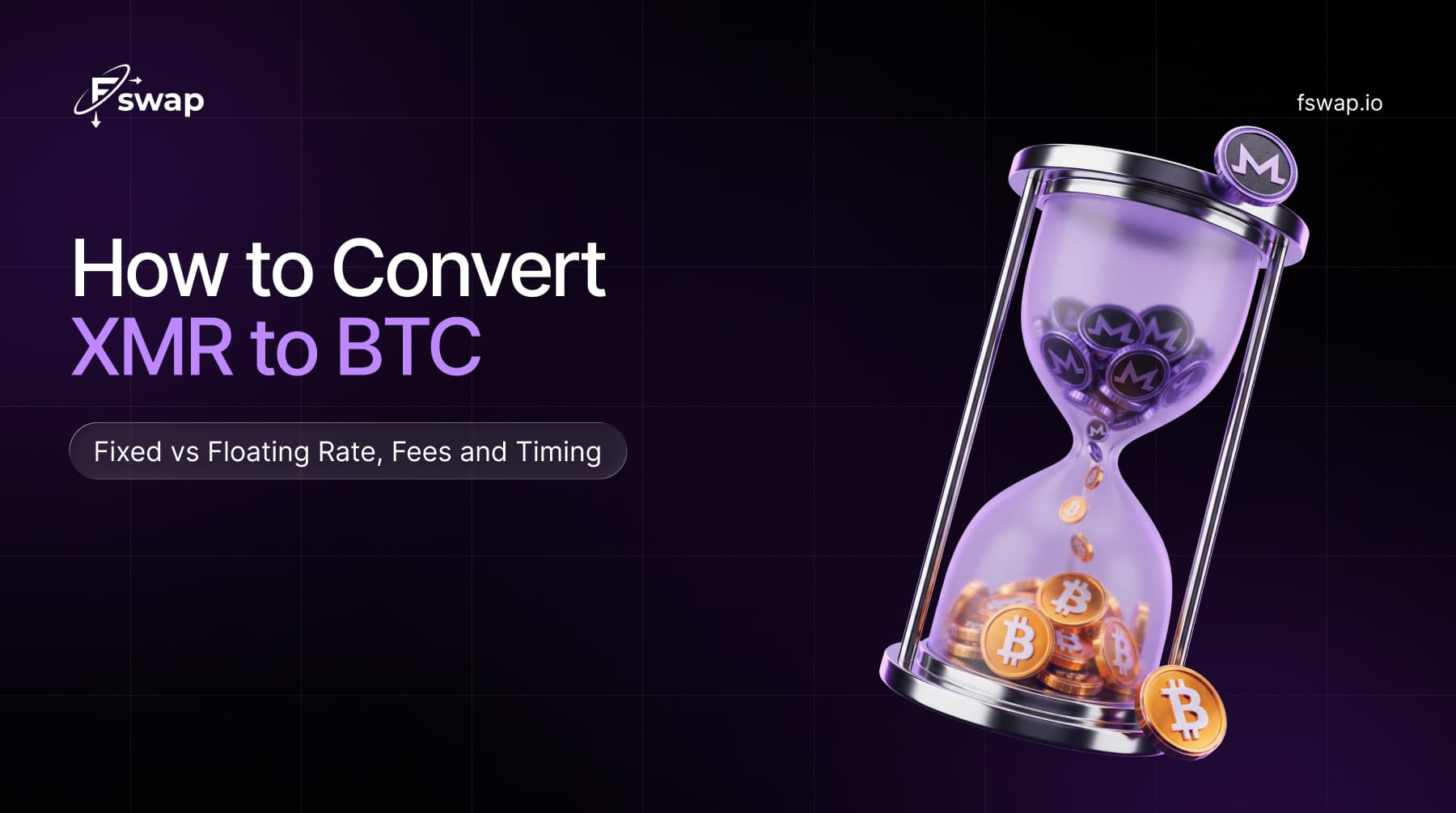
How do you convert XMR to BTC, and should you pick a fixed or a floating rate?
Send your Monero to a swap service and receive Bitcoin at an address you control. A fixed rate locks the BTC amount but demands the exact sum inside a short payment window. A floating rate settles once confirmations land. Choose fixed when certainty matters and floating when you want the market price at settlement.
A fixed rate guarantees the receive amount and carries a wider margin for it. Fswap's terms require the exact amount within up to 15 minutes, and a wrong or late payment can be recalculated at the market rate (Fswap Terms of Use, §2.9–2.11).
A floating order is determined "once the required number of confirmations is reached," so the final BTC figure can land above or below the quote (§2.7).
Monero locks every incoming output for 10 blocks, about 20 minutes (Feather Wallet docs; Monero Network Stats, 2026). Start a fixed-rate order only once it clears.
Network costs are small on both legs: Monero's median fee sits near $0.001, and Bitcoin at 1 to 2 sat/vB puts a payout near $0.12 to $0.23 (Monero Network Stats; mempool.space).
On Fswap the fee sits inside the quoted rate, so the number on the XMR to BTC page is what you receive. Compare it against a reference rate for the all-in cost.
Nothing connects Monero and Bitcoin directly. With no bridge contract and no shared address format between them, every conversion routes through a third party holding BTC liquidity.
The mechanics are the same everywhere. You enter the amount and your Bitcoin receive address, the service generates a one-time Monero deposit address, you send the XMR, and once the deposit confirms it broadcasts a Bitcoin transaction to you. Services differ in the rate type they offer and the margin they bury in the quote. Some also put an account between you and the payout.
If you need to acquire XMR first, our guide to buying Monero after the delistings covers the routes still open.
Before you send, check whether the service takes custody of your coins at any point. With no accounts there is no balance to hold, and the terms you agree to at order creation say as much: "we do not store users' funds" (§1), with §2.17 adding that "users' digital assets are not stored on the platform". You never register, and once the Bitcoin goes out there is nothing left to withdraw.
Both rate types describe the same swap. They differ in who absorbs price movement between your click and the final confirmation.
Fixed rate | Floating (market) rate | |
|---|---|---|
What is guaranteed | The exact BTC amount shown at order creation | Nothing until confirmations land |
When the price is set | At order creation | "Once the required number of confirmations is reached" (§2.7) |
Payment window | The exact amount, within up to 15 minutes (§2.10) | More forgiving, with no rate locked |
Margin in the quote | Wider, since the service carries the price risk | Tighter |
If the market moves hard | Movements of 1% or more allow recalculation (§2.12) | You take the movement in either direction |
Best for | A known BTC amount, or choppy prices | Large amounts, calm markets, patient senders |
Pick fixed when the receive figure feeds into something else, like a BTC-denominated invoice or a position you are sizing. The wider margin buys a number you can plan around.
Pick floating when you want the tightest price and can accept a range. Monero confirmations alone take about 20 minutes, and XMR has moved more than 1% inside that window many times. A floating order hands that to you, so whether fixed cost you more depends on which way the pair went.
This one catches experienced Monero holders. Monero locks every transaction output for 10 blocks before it becomes spendable. Feather Wallet's documentation states the consensus rule plainly: outputs are "locked (i.e. unspendable) for 10 blocks after the transaction that created them" (Feather Wallet docs). At an average block time of 120 seconds, that is close to 20 minutes (Monero Network Stats, 2026).
A fixed-rate order gives you up to 15 minutes to send the exact amount. If your XMR arrived a few minutes ago, the spendable balance is lower than the balance on screen, and the order expires before the lock clears. The service can then recalculate at the market rate, defeating the point of choosing fixed.
The sequence that works: check the spendable balance in your wallet, not the total, wait until the full amount clears, then create the order and send. Feather counts locked outputs as "unconfirmed" and shows remaining confirmations on hover.
The same lock applies to change coming back to your wallet, so two swaps in quick succession need a 20-minute gap. Swapping an amount that has already cleared sidesteps the wait.
Three costs sit on the conversion, and only two are visible.
Cost | Who sets it | Typical size |
|---|---|---|
Monero network fee on your send | The Monero network | Median around $0.001 (Monero Network Stats) |
Bitcoin network fee on the payout | The Bitcoin mempool | At 1 to 2 sat/vB, a ~141 vB payout costs 141 to 282 sat: $0.12 to $0.23 with BTC near $82,347 (mempool.space; CoinGecko) |
The service margin | The swap service | Built into the quoted rate; no published schedule (Terms, §2.6) |
Network fees barely register at these levels. The margin is where the money goes, and it takes thirty seconds to measure.
Take a reference rate from a market data site. XMR traded at 0.006739 BTC in early October 2026 (CoinGecko XMR/BTC), so two XMR is 0.013478 BTC at reference. A quote of 0.013343 BTC carries an all-in cost of 0.000135 BTC: 1.0% of the trade, or roughly $11.
Run the same check on a fixed and a floating quote and the certainty premium becomes a number. A headline fee of "0.5%" tells you nothing about the rate it applies to.
Stage | What is happening | Typical duration |
|---|---|---|
Before you begin | Incoming XMR clearing its 10-block lock | ~20 minutes, or zero if already spendable |
Order creation and payment | Sending the exact amount to the deposit address | Up to 15 minutes allowed (§2.10) |
Monero confirmation | Waiting on blocks | ~2 minutes per block |
Bitcoin payout | Broadcast, then first confirmation | Blocks average 10 minutes, and a confirmation "may arrive much sooner or much later" (bitcoin.org) |
Total | Order creation to BTC received | 5 to 15 minutes in normal conditions (Fswap XMR to BTC) |
Bitcoin's first confirmation is the one stage you cannot schedule. The payout shows as pending within seconds and becomes final when a miner includes it. For high-value transfers bitcoin.org suggests waiting for six, roughly an hour.
Sending a rounded amount to a fixed-rate order. The terms call for the exact figure. Sending 2 XMR against an order for 1.99847 XMR invites a recalculation.
Pasting a Lightning invoice as the receive address. The payout is an on-chain Bitcoin transaction. An on-chain address inside a Lightning wallet works; an invoice does not.
Reusing a Bitcoin address. Monero's privacy stops at the swap. A fresh receive address keeps the payout clear of your earlier activity.
Around 5 to 15 minutes once the order starts, most of it spent on Monero confirmations. Add about 20 minutes beforehand if your XMR is still locked.
The funds are inside the 10-block lock. Wait for the spendable balance to update, or swap a smaller portion that has already cleared.
On a floating order, yes, by design. On a fixed order the amount holds, unless you sent the wrong amount, missed the window, or the market moved 1% or more. Those cases fall under §2.11 and §2.12 of the terms.
Nothing on the Bitcoin chain points back to a Monero wallet. The link that can appear is behavioural: merging the payout with coins already tied to your identity.
Yes, through the BTC to XMR page. The timing flips, putting Bitcoin confirmations at the front and the Monero payout at the end.
Check your spendable Monero balance, pick the rate type that suits you, and swap. There is no account to open, and the fee is already inside the rate you see.
Elena leads marketing at Fswap and writes about cryptocurrency exchange: how swaps work, how to compare rates and fees, and how to keep funds safe without unnecessary KYC.