

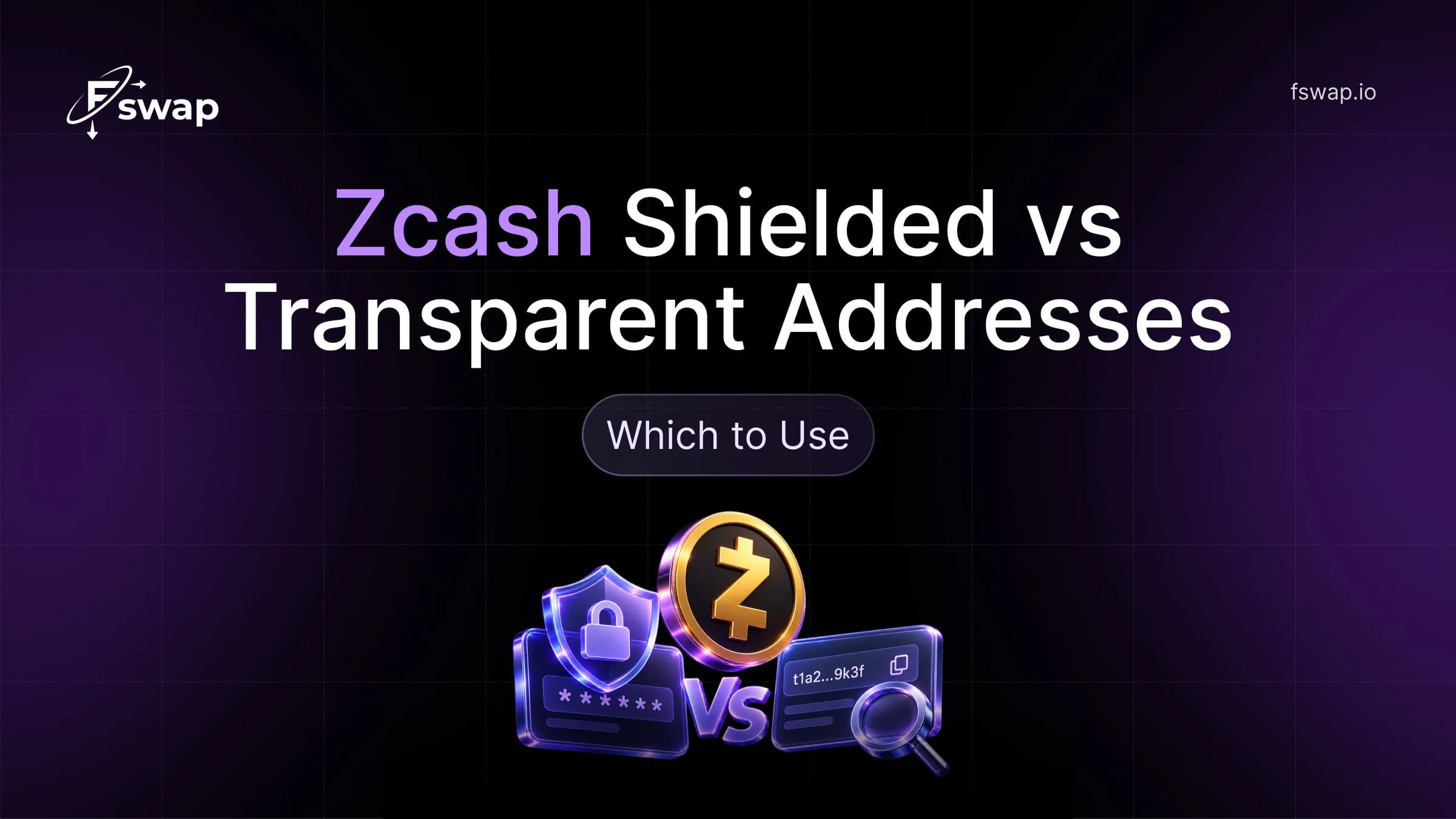
A transparent Zcash address publishes the sender, receiver and amount like Bitcoin. A shielded address encrypts all three on-chain. Use shielded for holding, transparent only when a service refuses anything else. Below: the address types compared, which exchanges accept shielded deposits or withdrawals, and which address to give after a swap.
A swap on Fswap pays out to the ZEC address you enter and needs no account — 4,300+ crypto pairs, fixed or floating rate, on the web or in a Telegram mini app.
Shielded holding is now the majority behaviour on Zcash: about 30% of circulating ZEC sat in shielded pools by May 2026, up from 8% in early 2024, and 59.3% of transactions were shielded in February 2026 (crypto.news, May 29, 2026).
The active shielded pool changed in 2026: Ironwood activated with NU6.3 on July 28, 2026 at block 3,428,143 after a soundness flaw was found in Orchard, with no evidence it was exploited. By September 10, 88.2% of the sealed Orchard balance had migrated (KuCoin, Sep 14, 2026).
A unified address (u1…) bundles several receivers, and ZIP 316 requires the sender to use the most private type it supports — Orchard first, then Sapling, then transparent (ZIP 316).
Exchange support is uneven: Gemini allows shielded withdrawals but takes deposits only to transparent addresses, Coinbase accepts shielded deposits yet withdraws only to transparent, and Kraken rejects shielded addresses entirely (CoinGape, Sep 11, 2026, data verified Aug 31, 2026).
If you hold legacy Sprout ZEC in a zc… address, act now: NU7 is planned for November 5, 2026 and would make Sprout funds unspendable, with the project due to confirm the date on October 20, 2026 (CryptoTicker, Sep 23, 2026).
Zcash is two systems sharing one chain. The transparent side behaves like Bitcoin: anyone can read the amounts and trace the flow. The shielded side uses zero-knowledge proofs, so the chain verifies the transaction is valid without publishing who sent what to whom.
The practical rule in four lines:
Hold in shielded. That is the pool's purpose, and roughly 30% of all ZEC is already there.
Use a transparent address only when forced — most often because an exchange will not send to anything else.
Prefer a unified address (u1…) when the sender supports it: the protocol then routes to the most private receiver available.
Shield after receiving if the payout had to be transparent. Moving funds from your own t-address into your own shielded address is one ordinary transaction.
Four formats exist, and they are not interchangeable.
Transparent addresses start with t1 (pay-to-public-key-hash) or t3 (pay-to-script-hash). They are Bitcoin-style accounts: balances and transaction history are permanently public.
Sapling addresses start with zs. This was the first widely usable shielded format and remains valid and spendable, though it is no longer where new activity concentrates.
Unified addresses start with u1 under ZIP 316 revision 0. A unified address is a container: it can hold an Orchard receiver, a Sapling receiver and transparent receivers, each tagged with a typecode. The spec then binds the sender's behaviour — a wallet "must use the receiver of the most preferred type that it supports", in the order Orchard, Sapling, transparent. That is why a unified address is the safest thing to hand out: a modern wallet will automatically pay you shielded, while an older one falls back to something it can actually construct. Revision 2 adds two stricter variants, zu for shielded-only addresses and tu for those that permit transparent receivers.
Sprout addresses start with zc and date from 2016–2017. These are a liability now rather than an option. NU7, planned for November 5, 2026, would disallow the only transaction format capable of spending Sprout funds, which means those coins stop being spendable — not burned, just frozen. Sprout addresses cannot be restored from a seed phrase, so the old wallet file is the only key. If that describes any of your holdings, migrate before the date is confirmed on October 20, 2026.
The shielded pool itself was replaced this year. After a soundness vulnerability was found in Orchard on May 29, 2026 — with no evidence of exploitation — the Ironwood pool activated through NU6.3 on July 28, 2026, at block 3,428,143. Its balance-integrity properties were machine-checked with more than 2,700 theorems in the Lean theorem prover, under stated cryptographic assumptions.
Three consequences for ordinary holders. New Orchard outputs are no longer created, so the move to Ironwood is one-way. Existing transparent, Sapling and Orchard funds remain valid and spendable, but migrating Orchard balances requires a wallet with explicit ZIP 318 support — recognising Ironwood funds is not the same as offering migration. And the legacy zcashd node reached end of support before NU6.3 and cannot handle Ironwood at all; the network is moving to the Rust-based Zebra node.
Address type | Prefix | What the chain reveals | Exchange acceptance | Status in 2026 |
|---|---|---|---|---|
Transparent P2PKH / P2SH |
| Sender, receiver and amount, permanently | Universal | Fully supported; the default on most exchanges |
Unified address |
| Depends on the receiver used: nothing if Orchard or Sapling, everything if the sender falls back to transparent | Growing but incomplete — some services still reject the format outright | The recommended format to share |
Sapling shielded |
| Nothing beyond the fact a shielded transaction occurred | Limited; several swap routes reject | Valid and spendable, no longer the growth pool |
Orchard shielded | Receiver inside a unified address | Nothing beyond the fact a shielded transaction occurred | Via unified addresses only | Sealed to new outputs since NU6.3; migrate to Ironwood |
Sprout shielded |
| Nothing beyond the fact a shielded transaction occurred | Effectively none | Legacy; would become unspendable under NU7 |
Ordered from the most revealing format to the least, then by how current each one is. Prefixes and receiver rules per ZIP 316; pool status per KuCoin's Q3 2026 Zcash review (Sep 14, 2026); Sprout timing per CryptoTicker (Sep 23, 2026). Formats change with network upgrades — check your wallet's release notes before moving a large balance.
One nuance the table compresses: a shielded transaction is not invisible, it is unreadable. Observers can see that a shielded transaction happened and roughly when. What they cannot see is the addresses or the amount. The privacy comes from the size of the pool you are hiding inside, which is why the rise from 8% of supply shielded in early 2024 to over 30% by May 2026 matters more than any single feature.
This is where theory meets a validation error message. Support splits by direction — an exchange may accept a shielded deposit yet refuse to withdraw to one, or the reverse.
Exchange | Shielded deposits | Shielded withdrawals | Notes |
|---|---|---|---|
No — transparent only | Yes | ZEC trading unavailable to customers in the UK, EU/EEA and Singapore | |
Yes | No — transparent only | Single ZEC/USD spot pair | |
No — rejects shielded addresses | No | 35 spot pairs, but ZEC delisted in India and the UAE in 2026 | |
Not documented | Not documented | ZEC listed with regional restrictions; assume transparent unless the deposit page says otherwise |
Ordered by how much shielded support each venue documents, most first. Source: CoinGape's Zcash exchange tracker (Sep 11, 2026, data verified Aug 31, 2026). Exchange policies and regional availability change frequently — confirm on the deposit or withdrawal screen itself.
Two things worth planning around. First, "not documented" is not the same as "supported": if a deposit page offers no shielded option, treat the venue as transparent-only. Second, the regulatory direction is visible on the calendar — CoinGape notes that exchanges serving the EU face a rule starting July 10, 2027 that may push them to restrict how they handle shielded transactions. None of that affects what your own wallet can do with your own keys, but it does affect which deposit addresses will still be accepted.
The address you paste into a swap form decides whether the payout is readable on-chain. Give a transparent address and the arriving amount is public forever; give a shielded or unified one and it is not.
Route to a shielded ZEC balance | What it requires first | Steps until the ZEC is shielded and yours |
|---|---|---|
Fswap (non-custodial swap) | A ZEC address from your own wallet; no account | One swap, plus one in-wallet shielding transaction if the form only accepts a transparent address |
Gemini | Account, verification, and availability in your region | Buy or deposit, then withdraw directly to a shielded address |
Coinbase | Account and verification | Buy, withdraw to your transparent address, then shield it yourself |
Kraken | Account and verification; ZEC available in your country | Buy, withdraw to a transparent address only, then shield it yourself |
Ordered by how many accounts and verification steps stand between you and ZEC in your own shielded balance, fewest first.
In practice, swapping into ZEC through Fswap means pasting the receiving address from your own wallet — for example on ZEC to BTC in reverse, or straight from stablecoins via USDT ERC20 to ZEC. Because there is no account, fewer intermediaries collect your data along the way than in a deposit-trade-withdraw cycle — though the chain still records what it records, which is the distinction our guide to an anonymous crypto exchange spends most of its length on.
Copy the address from the wallet's own Receive screen, not from a note or a chat.
Prefer the unified address if the wallet shows one; keep the transparent address for services that reject u1 strings.
If the form rejects your shielded address, use your own transparent address and shield the funds yourself afterwards — do not send to a third party's shielded address instead.
Check your wallet supports NU6.3 and Ironwood before moving a large balance.
Keep the order ID and the payout transaction hash until the balance shows in your wallet.
Reusing one transparent address for everything. Every incoming payment to a t1 address joins a single public history that anyone can read in full.
Treating a unified address as automatically private. It routes to the most private receiver the sender supports. An old wallet that only understands transparent receivers will pay you transparently, in public.
Sharing a unified address that still contains a transparent receiver. Some wallets changed this default precisely because it linked a user's shielded and transparent sides; check what your Receive screen is actually handing out.
Shielding and unshielding the same amount immediately. Moving an identical value in and straight back out narrows the guesswork for anyone watching the pool boundaries.
Assuming an exchange will return funds to the address you used. Where withdrawals are transparent-only, a shielded deposit is a one-way door.
Leaving legacy Sprout ZEC untouched. With NU7 planned for November 5, 2026, "later" may mean never — and migration takes days or weeks, not minutes.
An address whose transactions are encrypted on-chain using zero-knowledge proofs, so the sender, receiver and amount are not published. Sapling shielded addresses start with zs; newer shielded receivers are delivered inside unified addresses starting with u1.
A transparent address (t1 or t3) publishes sender, receiver and amount exactly like Bitcoin. A shielded address proves the transaction is valid without revealing those details. Both live on the same blockchain, and moving between them is an ordinary transaction.
A unified address when the sender accepts one, because ZIP 316 makes the sender use the most private receiver it supports. Use a transparent address only when a service refuses anything else, then shield the funds from your own wallet afterwards.
Some do, in one direction only. As of data verified on August 31, 2026, Gemini supported shielded withdrawals with transparent-only deposits, Coinbase the reverse, and Kraken rejected shielded addresses entirely. Check the deposit or withdrawal page before sending.
Only when you use the shielded pool. A transparent ZEC transaction is as traceable as a Bitcoin one. Shielded usage is now substantial — about 30% of circulating supply and 59.3% of transactions in February 2026 — and a larger pool means better privacy for everyone in it.
A soundness vulnerability was found on May 29, 2026, with no evidence of exploitation. The Ironwood pool activated through NU6.3 on July 28, 2026 at block 3,428,143, new Orchard outputs stopped, and holders began a one-way migration — 88.2% of the sealed balance had moved by September 10.
Migrate it now. NU7, planned for November 5, 2026, would make Sprout funds unspendable, and Sprout addresses cannot be recovered from a seed phrase — only from the original wallet file. Back that file up first and expect migration to take days or weeks.
Hand out a unified address by default, keep a transparent one for the services that still demand it, and shield anything that arrives in the open. Before any large move, confirm your wallet speaks NU6.3 and Ironwood, and check whether the exchange on the other end accepts shielded addresses in the direction you need. If a zc address is anywhere in your history, deal with it this month.
Want ZEC in your own wallet rather than an exchange balance? Get a live quote on Fswap — 4,300+ pairs, payout to the address you choose, no account, on the web or in Telegram.
Elena leads marketing at Fswap and writes about cryptocurrency exchange: how swaps work, how to compare rates and fees, and how to keep funds safe without unnecessary KYC.