What Is a Memo or Destination Tag in Crypto and When Do You Need One?
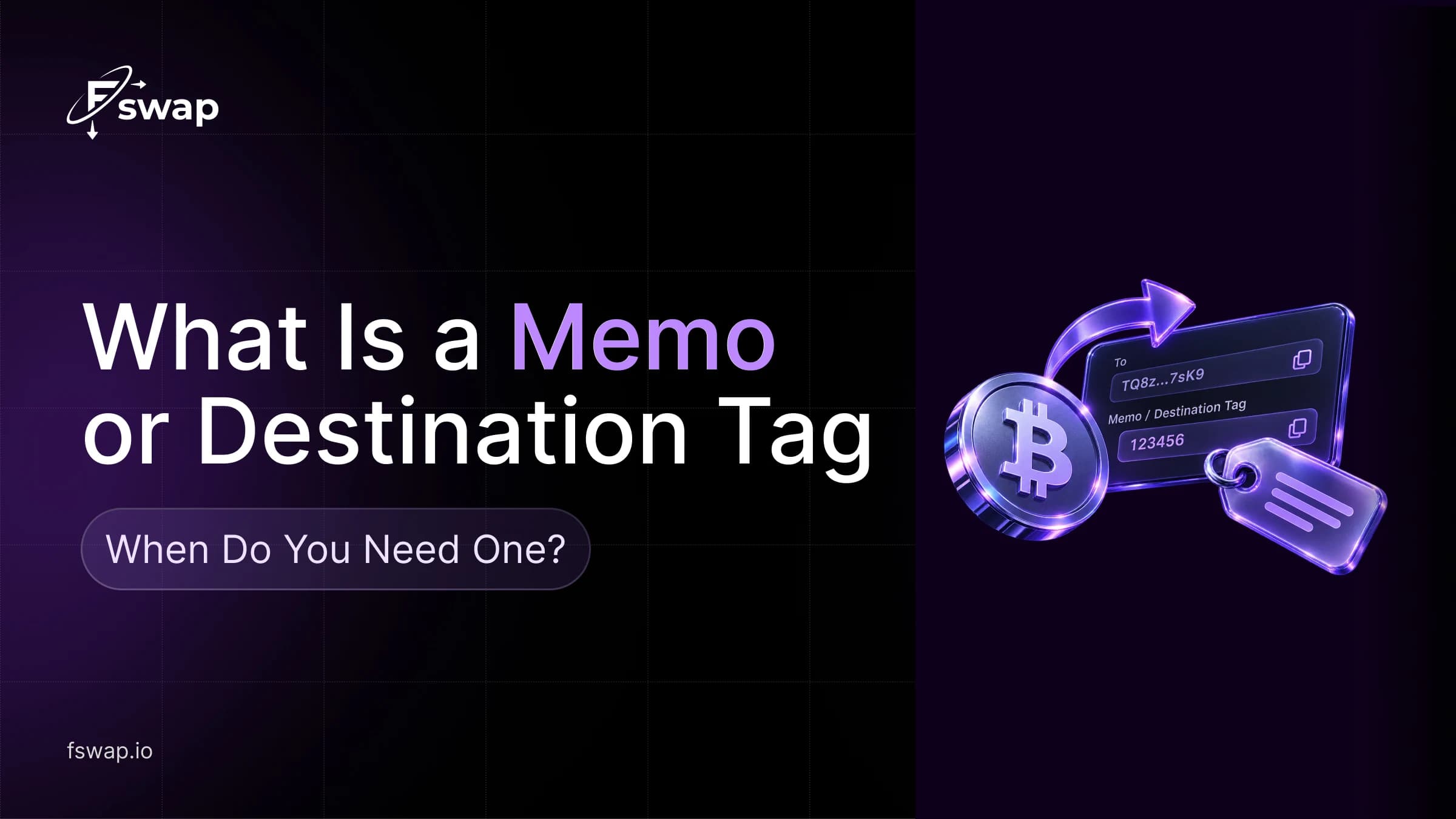
A memo or destination tag is a short identifier you attach to a transfer so a service sharing one deposit address knows which customer to credit. You need it when sending to an exchange, never when sending to your own wallet. Below: the coins that require one, the exact format for each, and what to do if you forgot it.
Key takeaways
Swaps on Fswap pay out to an address you control, so no memo is needed on the receiving side — 4,300+ crypto pairs, no account, fixed or floating rate, on the web or in a Telegram mini app.
On the XRP Ledger, destination tags are 32-bit unsigned integers (0 to 4,294,967,295) and are not required by the protocol — they only tell off-ledger systems how to process a payment (XRPL docs).
Businesses can switch on the
RequireDestsetting, after which the XRP Ledger rejects untagged payments outright instead of crediting an unidentifiable deposit (XRPL docs).Stellar supports four memo types: MEMO_TEXT up to 28 bytes, MEMO_ID as a 64-bit unsigned integer, and MEMO_HASH and MEMO_RETURN as 32-byte hashes (Stellar developer docs).
Coinbase lists thirteen assets that need a memo — AKT, AXL, TIA, ATOM, DYDX, EOS, HBAR, KAVA, OSMO, SEI, STX, XLM and ZETA — plus XRP, which uses a tag (Coinbase Help).
Recovery is possible but not free: Bybit charges five times the standard withdrawal fee, accepts requests only for deposits made in the last 180 days and after January 22, 2024, and replies within 1–3 working days (Bybit Help Center).
In this article
What is a memo or destination tag?
It is a routing label, nothing more. The blockchain delivers your coins to an address; the memo tells whoever controls that address which internal account the money belongs to.
The reason it exists is architectural. On networks like XRP, Stellar, Cosmos and TON, creating a separate on-chain address per customer is expensive or impractical, so an exchange keeps one address for an entire asset and distinguishes deposits by the identifier attached to each transfer. Your memo is how a $500 deposit becomes your $500 instead of an unlabelled arrival in a pooled wallet.
Three terms, same job:
Destination tag — the XRP Ledger's name for it. Technically a 32-bit unsigned integer, so any whole number from 0 to 4,294,967,295.
Memo — the term on Stellar, Cosmos-based chains, EOS and Hedera. Depending on the network it can be a number or a short text string.
Comment — what TON wallets call the same field.
Worth knowing: none of these are required by the blockchains themselves. The XRPL documentation is explicit that tags "do not have direct on-ledger functionality" and "merely provide information about how off-ledger systems should process a payment". The requirement comes from the recipient, not the chain — which is exactly why the network will happily let you send without one.
Which coins need a memo or tag
The list below covers the assets where a missing identifier causes a stuck deposit. Field names and formats differ, and copying a tag into a memo field or vice versa does not work.
Asset | Field name | Format | Needed when |
|---|---|---|---|
XRP | Destination tag | 32-bit unsigned integer, 0–4,294,967,295 | Depositing to any exchange or custodial service |
Stellar (XLM) | Memo | Text up to 28 bytes, 64-bit integer ID, or 32-byte hash | Depositing to an exchange; memo type must match what they ask for |
Cosmos (ATOM) | Memo | Text string | Depositing to an exchange |
Osmosis (OSMO), Celestia (TIA), Akash (AKT), Axelar (AXL), KAVA, SEI, dYdX, ZetaChain | Memo | Text string | Depositing to an exchange — the Cosmos SDK pattern applies across these chains |
EOS | Memo | Text string | Depositing to an exchange |
Hedera (HBAR) | Memo | Text string | Depositing to an exchange |
Stacks (STX) | Memo | Text string | Depositing to an exchange |
TON and Jettons (including USDT on TON) | Comment | Text comment attached to the transfer | Depositing to an exchange or a custodial bot wallet |
Assets requiring a memo or tag per Coinbase Help; formats for XRP from the XRPL documentation and for Stellar from the Stellar developer docs; TON comment behaviour per Wallet's exchange-deposit guide. Requirements are set by the receiving service — always use the memo shown on its own deposit page.
Two patterns are worth remembering rather than memorising the list. First, if a chain was designed around account models with cheap internal bookkeeping — XRP, Stellar, Cosmos, EOS, Hedera, TON — assume a memo is in play. Second, the memo is always specific to one account at one service: a tag from your Binance XRP deposit page is meaningless at Kraken, and reusing it sends your funds into someone else's accounting.
When you need one — and when you do not
The deciding question is never the coin. It is who controls the receiving address.
Where you are sending | Memo needed? | Why |
|---|---|---|
Payout from a swap on Fswap to your own wallet | No | The address is yours alone; there is nothing to disambiguate |
Your own self-custody wallet | No | One address, one owner |
Another person's personal wallet | No, but harmless | A memo may be used as a note; it changes nothing about delivery |
A custodial bot or wallet service | Usually yes | These often pool balances behind one address |
An exchange deposit address | Yes, for the assets in the table above | One shared address serves every customer holding that asset |
Ordered by how likely a memo is required, least likely first.
The asymmetry matters: forgetting a memo when none was needed costs nothing, and forgetting one that was needed can cost the whole transfer. When in doubt, read the deposit page.
Where to enter the memo when swapping
A swap has two legs, and the memo question applies to each separately.
On the receiving leg, you give the swap service the address where the coins should land. If that address is your own wallet, there is no memo to enter. If you are routing the payout straight to an exchange — converting TON and sending the result to your Binance account, say — then the memo belongs here, in the field next to the receiving address, copied from that exchange's deposit page.
On the sending leg, the swap service gives you its deposit address. Send exactly what the order says. Some services generate a unique deposit address per order and need no memo at all; others display a memo you must include. Read the order screen rather than assuming, because this is one of the two places where a correct amount can still fail to arrive.
The practical sequence, using a TON swap as the example:
Decide the final destination first — own wallet or exchange account.
If it is an exchange, open its deposit page for that exact asset and network, and copy both the address and the memo or comment.
Paste both into the swap form; confirm the memo field is not left empty when one was shown.
Follow the deposit instructions on the order screen exactly, including any memo the service asks for on its own address.
Keep the order ID and both transaction hashes until the funds are credited.
Routing a payout into your own wallet first and only then moving it onward costs one extra network fee and removes the memo risk entirely — on Fswap that simply means pasting your own address instead of an exchange's. On TON the extra hop is cheap; the guide to swapping TON covers the gas rules that make Jetton transfers behave differently from plain TON. Pairs like TON to BTC or USDT TON to USDT BEP20 also let you move value off a memo-dependent network entirely — BEP20 deposits never need one.
What if you forgot the memo?
The funds are not usually destroyed. They arrived at the right address with no instructions attached, so they sit in the service's pooled wallet until a human links them to your account. Recovery depends entirely on that service's policy.
Do this, in order:
Stop sending. Do not repeat the transfer "correctly" hoping the first one resolves itself. Two unresolved deposits are harder to untangle than one.
Collect the evidence. The transaction hash, the exact amount, the asset and network, the sending address, and the date and time.
Open a ticket with the receiving service, not the sender. Only whoever controls the destination address can credit or return the funds. Coinbase, for instance, asks for the transaction hash and says it "may be able to assist" with recovery — while noting it cannot retrieve funds you sent out to someone else.
Expect a fee and a deadline. Bybit's published terms are representative: a handling fee of five times the standard withdrawal fee, eligibility limited to deposits from the last 180 days and made after January 22, 2024, a refund sent back to the source address, and an automated reply within 1–3 working days. The net amount must also exceed the coin's minimum withdrawal, or the request is not processed.
Be patient but persistent. Some services resolve these on the day of the request; others quote up to two weeks for specific tokens. If nothing arrives after the stated window, escalate in the same ticket rather than opening a new one.
If the destination address belonged to an individual rather than a service, there is no recovery process — only a conversation with that person.
Mistakes that turn a memo into a support ticket
Reusing an old memo. A tag identifies one account at one service. Memos saved in your notes app go stale when the exchange rotates deposit details.
Putting the memo in the wrong field. An XRP destination tag is a number; a Stellar memo may be text, an ID or a hash. A text memo pasted where an integer is expected is simply rejected.
Exceeding the length limit. Stellar's MEMO_TEXT caps at 28 bytes. A longer string will not go through, and non-ASCII characters eat more than one byte each.
Assuming the memo is optional because the wallet sent it anyway. The chain does not enforce memos unless the recipient enabled something like XRPL's
RequireDest. A successful transaction is not a credited deposit.Sending a memo-free test and then the full amount. If the test does not arrive, you have two recoveries to request instead of one.
Copying the address from a chat and the memo from a page. Both belong to the same deposit screen; mixing sources is how people pay a stranger's account.
FAQ
What is a memo in crypto?
A short identifier attached to a transfer so a service using one shared deposit address can tell which customer the funds belong to. It is called a memo on Stellar, Cosmos, EOS and Hedera, a destination tag on XRP, and a comment on TON.
What is a destination tag for XRP?
A 32-bit unsigned integer between 0 and 4,294,967,295 that identifies an account at the receiving service. The XRP Ledger does not require it; exchanges do, because a single XRP address serves all of their customers.
Which coins need a memo or destination tag?
Coinbase lists AKT, AXL, TIA, ATOM, DYDX, EOS, HBAR, KAVA, OSMO, SEI, STX, XLM and ZETA as memo assets, plus XRP for tags. TON and Jettons use a comment. Other Cosmos-based chains follow the same pattern.
Do I need a memo when sending to my own wallet?
No. A memo only matters when one address serves many accounts. Your self-custody wallet address is yours alone, and a payout from a swap into it needs no memo.
What happens if I forget the destination tag or memo?
The transfer confirms on-chain but is not credited to your account; it waits in the receiving service's pooled wallet. Contact that service with the transaction hash, amount, asset and network. Recovery is common but may cost a fee and take days.
Can I recover crypto sent without a memo?
Usually, if the destination was an exchange. Bybit, for example, charges five times the standard withdrawal fee, accepts requests only for deposits from the last 180 days and after January 22, 2024, and returns the funds to the source address. If the recipient was an individual, there is no process — only their cooperation.
Is a memo the same as a comment in TON?
Yes, functionally. TON wallets label the field "comment", and exchanges use that text to match a deposit to an account. Leaving it blank on an exchange deposit has the same consequence as a missing XRP tag.
Conclusion
Treat the memo as part of the address, not an optional note. Before any transfer, decide where the funds are finally going: to your own wallet, and no memo is needed; to an exchange, and you copy the address and the memo together from the same deposit page, in the format that network expects. If you already sent without one, stop, gather the hash and open a ticket with the receiving service — it is usually recoverable, for a fee.
Need coins in your own wallet instead of an exchange account? Get a live quote on Fswap — 4,300+ pairs, payout to the address you choose, no account, on the web or in Telegram.

Elena leads marketing at Fswap and writes about cryptocurrency exchange: how swaps work, how to compare rates and fees, and how to keep funds safe without unnecessary KYC.