

Which USDT network is cheapest in 2026?
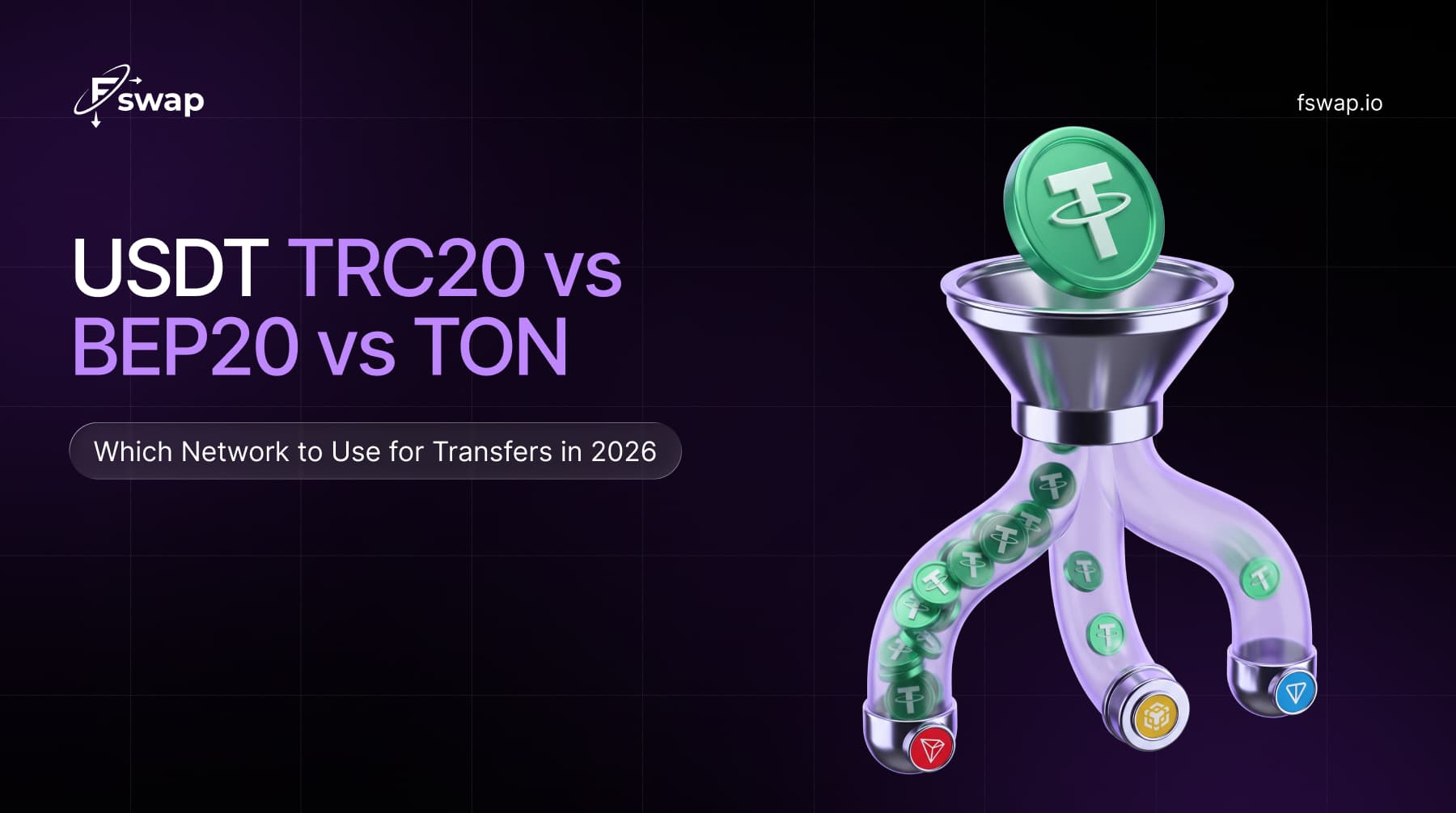
TON and BEP20 both cost a fraction of a cent per transfer, while TRC20 costs around $2 unless you rent energy on Tron. TRC20 still wins on acceptance, since more exchanges and counterparties list it than either alternative. The table below prices all three and covers what the fee comparison leaves out.
Measured across 30 days of real transfers, the median USDT transfer cost $0.0016 on TON, $0.0021 on BNB Smart Chain and $2.17 on Tron when burning TRX, as of 22 September 2026 (Cryptum Pay, September 2026).
Tron fees halved in 2025. Proposal #104, passed on 29 August 2025, cut the energy unit price from 210 to 100 sun, taking a standard transfer to roughly 6.4 TRX for a recipient who already holds USDT and 13.4 TRX for an empty wallet (Tronsave, July 2026).
The token everyone calls USDT BEP20 is not issued by Tether. Tether's own transparency page reports $0.00 net circulation on BNB Smart Chain, and the contract wallets label "USDT" there is Binance-Peg BSC-USD, issued and backed by Binance (Tether Transparency).
Tron carries the bulk of the supply, holding more than $90 billion of USDT and handling around $23.8 billion in daily transfers, which is why it remains the default despite being the most expensive of the three (Datawallet, August 2026).
Switching networks does not mean selling. Fswap swaps USDT directly between networks with no account, including TRC20 to BEP20 and TON to BEP20.
TRC20 (Tron) | BEP20 (BNB Smart Chain) | TON | |
|---|---|---|---|
Median transfer fee | $2.17 burning TRX | $0.0021 | $0.0016 |
Fee to a new recipient | Roughly double | $0.0035 | $0.0032 |
Gas paid in | TRX | BNB | TON |
Address format | Starts with T | Starts with 0x | TON format, often UQ or EQ |
Settlement | ~3 seconds | ~3 seconds | ~5 seconds |
Issued by | Tether | Binance, as a pegged token | Tether |
Acceptance | Widest | Wide | Narrower, strong in Telegram |
Two details in that table do more work than the fees. The gas row explains why transfers fail: every network charges in its own coin, so USDT alone in a wallet cannot move anywhere. And the address row explains how people lose money, because BEP20 and ERC20 addresses are both 0x strings and look identical.
Tron prices transfers through a resource system rather than a simple gas fee. A USDT transfer consumes energy, and a wallet holding no staked TRX burns TRX instead. That comes to roughly 6.4 TRX when the recipient already holds USDT, and about 13.4 TRX when the address has never received it, because activating a fresh balance costs twice the energy. Staking TRX or renting energy through a marketplace cuts the per-transfer cost substantially, which is how heavy users keep it near a dollar.
BNB Smart Chain and TON both charge small enough amounts that the arithmetic stops mattering. On a $50 transfer, TON takes about half a cent and BNB Smart Chain slightly more.
TON adds one wrinkle worth knowing. USDT there is a jetton, and every holder has a separate small wallet contract for the token. Sending to someone who has never held USDT on TON creates that contract as part of the transfer, which doubles the median cost from $0.0016 to $0.0032. Still trivial, and it explains why the same transfer quotes two different fees.
Check which TON token you hold. The network carries jUSDT, an older bridged USDT, as a separate token with its own contract (ton.app jetton listing).
The fee you pay at an exchange is a separate charge from the network fee and is often larger than it. Withdrawal fees are set by the platform, not the chain, so a network that costs a fraction of a cent on-chain can still cost a dollar to leave an exchange.
Nearly every comparison of these networks describes BEP20 as Tether's stablecoin running on BNB Smart Chain. Tether's own numbers say otherwise.
The transparency page where Tether publishes per-chain issuance lists BNB Smart Chain with $0.00 authorized and $0.00 in net circulation. The token that wallets and exchanges label USDT on that network is a different asset: contract 0x55d398326f99059ff775485246999027b3197955, named Binance-Peg BSC-USD. Binance mints it against USDT held in its own custody and redeems it the same way (CoinRanking, September 2026).
For everyday transfers this changes nothing. The token holds its dollar peg, trades everywhere on BNB Chain, and moves for a fraction of a cent. For anyone holding size, it changes one thing: the redemption path runs through Binance rather than Tether, so you are relying on Binance's custody and bridge operation on top of Tether's reserves. TRC20 and TON USDT are both minted by Tether directly, carrying reserve risk alone.
That is a reason to think about size and duration rather than a reason to avoid the network. Moving money through BEP20 is fine. Parking a large balance there for a year is a different decision, and one most articles never present.
Sending to an exchange. Check which networks it credits before anything else, then pick the cheapest one on that list. TRC20 is listed almost everywhere, which is usually why people end up paying for it.
Sending to someone in Telegram. TON, without much competition. The wallet is built into the app and the recipient needs nothing installed.
Moving between your own wallets. BEP20 or TON. Both cost almost nothing and settle in seconds.
Using BNB Chain DeFi. BEP20, since that is where the liquidity sits.
Paying someone who only gave you a T address. TRC20, and budget a couple of dollars for it.
Holding a large balance long term. A Tether-issued version, so TRC20 or TON rather than the pegged BEP20 token.
Holding USDT on the wrong network is common and easy to fix. You do not need to sell to dollars, buy back, or open an account somewhere to do it.
A direct swap converts USDT on one network into USDT on another in a single step. On Fswap that runs with no registration across 4,300+ pairs, usually in a few minutes, with pages for the common routes including USDT TRC20 to BEP20, BEP20 to TRC20 and TON to BEP20.
One practical note that applies whatever route you use: send a small test amount the first time you use a new address or network. The fee on BEP20 or TON is small enough that testing costs nothing, and on TRC20 a couple of dollars is cheap against the alternative.
Same dollar value, different tokens on different networks, and they are not interchangeable. The TRC20 version is issued by Tether on Tron. The BEP20 version is Binance-Peg BSC-USD, issued by Binance against USDT it holds. Sending one to an address on the other network does not work.
Usually the funds are stranded rather than destroyed, and recovery depends entirely on whether whoever controls the receiving address can access it on the other chain. An exchange may or may not help. The risk is highest between BEP20 and ERC20, since both use identical 0x addresses.
Because gas is paid in the network's own coin. Sending USDT needs TRX on Tron, BNB on BNB Smart Chain, or TON on TON. A wallet holding only USDT cannot send it.
No. Sending 10 USDT and 10,000 USDT costs the same on all three networks, since the fee prices computation rather than value. This is why small transfers on TRC20 feel expensive and large ones feel cheap.
Acceptance. Tron holds more than $90 billion of USDT and nearly every exchange, wallet and counterparty lists it, so it is the network you can be confident the other side will credit.
Yes. An instant swap takes USDT on one network and sends USDT on another to an address you control, with no registration and no identity check. The same approach works when you want to exit a position without KYC.
Picking a network is mostly about what the other side will accept, and the fee only decides it when both sides already work.
Check a live rate on Fswap for any USDT route across 4,300+ pairs, with no account, or run it from Telegram through @fswap_official_bot.
Elena leads marketing at Fswap and writes about cryptocurrency exchange: how swaps work, how to compare rates and fees, and how to keep funds safe without unnecessary KYC.