Fswap Private Mode: Crypto Swaps Without KYC Requests
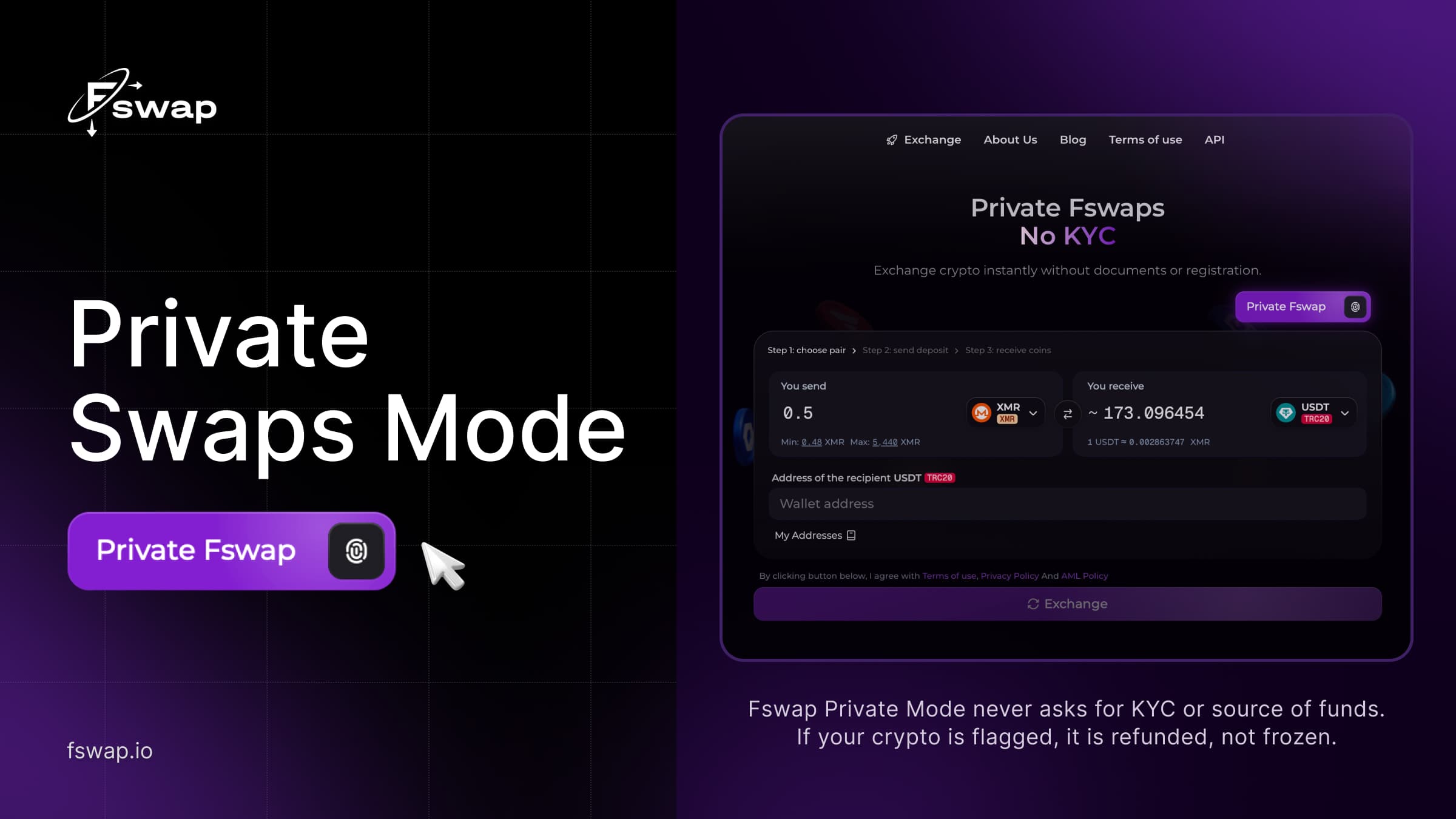
Fswap now has a dedicated Private Mode — a swap mode built on one commitment: no KYC requests, no source-of-funds requests, ever. If your crypto doesn't pass screening, it's refunded to you instead of being held pending review. It's a single toggle on the exchange widget, with no account and no application.
Here's why that matters.
Why Swaps Get Frozen Mid-Exchange
Plenty of crypto-to-crypto services advertise "no registration, no KYC" — right up until the moment an automated risk check flags something. Then the service that promised no verification starts asking for your ID, bank statements, and documentation of where your crypto came from, while your funds sit in limbo.
Screening providers like Chainalysis, Elliptic, or BitOK assign every incoming transaction a risk score by category — mixer, darknet, scam, gambling. Many services treat a total risk above 50%, or a single high-risk category above 10%, as a problem, and none publish their exact thresholds. As of 2025, around 92% of centralized platforms enforce identity checks, and the practice has spread to instant swap services too.
Two things make this worse than it sounds. Passing KYC doesn't protect you — there are documented cases of users who completed full verification, including face checks, and still had funds held for months. And plenty of flagged crypto belongs to people who did nothing wrong: risk scores are inherited, so coins from a P2P trade, an old wallet, or a sender with mixed history can carry a score you never created and couldn't have seen.
How Private Mode Works
- No identity verification, ever. No documents, selfies, or personal data — not at the start of a swap, not mid-swap, not as a condition of releasing funds.
- No source-of-funds requests. You're never asked to document where your crypto came from.
- Flagged funds are refunded, not frozen. Screening still runs, but crypto that doesn't pass is returned to you rather than held for review.
That last point is the substantive difference. Most services resolve a flag by demanding documents; Private Mode resolves it by declining the swap and giving your crypto back. You either get your exchange or you get your funds returned — those are the only two outcomes.
You Can Track Every Swap Yourself
From the moment you send your funds, Fswap generates a unique identifier for your swap — a unique identifier you can use to follow the exchange from start to finish. Nothing about the process is hidden from you.
How to Turn It On
- Open the swap widget on Fswap.
- Switch the toggle to Private Mode.
- Set up your swap as usual — send from a wallet you control, and enter your receiving address.
FAQ
Will I ever be asked for KYC in Private Mode?
No. The mode is defined by the absence of identity verification and source-of-funds requests. If a transaction doesn't pass screening, it's refunded rather than held pending documentation.
What happens if my crypto is flagged as high-risk?
It's returned to the address it was sent from. The swap doesn't complete, but your funds aren't frozen and you're never asked to submit documents to get them back.
Why would clean crypto get flagged?
Risk scores are inherited. Coins received from a P2P trade, an older wallet, or a sender with mixed history can carry a score you had no part in creating — which is why many flagged users are ordinary people rather than bad actors.
Can I track my swap without an account?
Yes. A transaction hash is generated the moment you send your funds, and you can use it to follow the swap or check it independently in any public block explorer.
Try It Yourself
You can try private swaps here — just switch the toggle on the widget at Fswap.

Elena leads marketing at Fswap and writes about cryptocurrency exchange: how swaps work, how to compare rates and fees, and how to keep funds safe without unnecessary KYC.