Gas Fees Compared: TRON vs Ethereum vs BSC
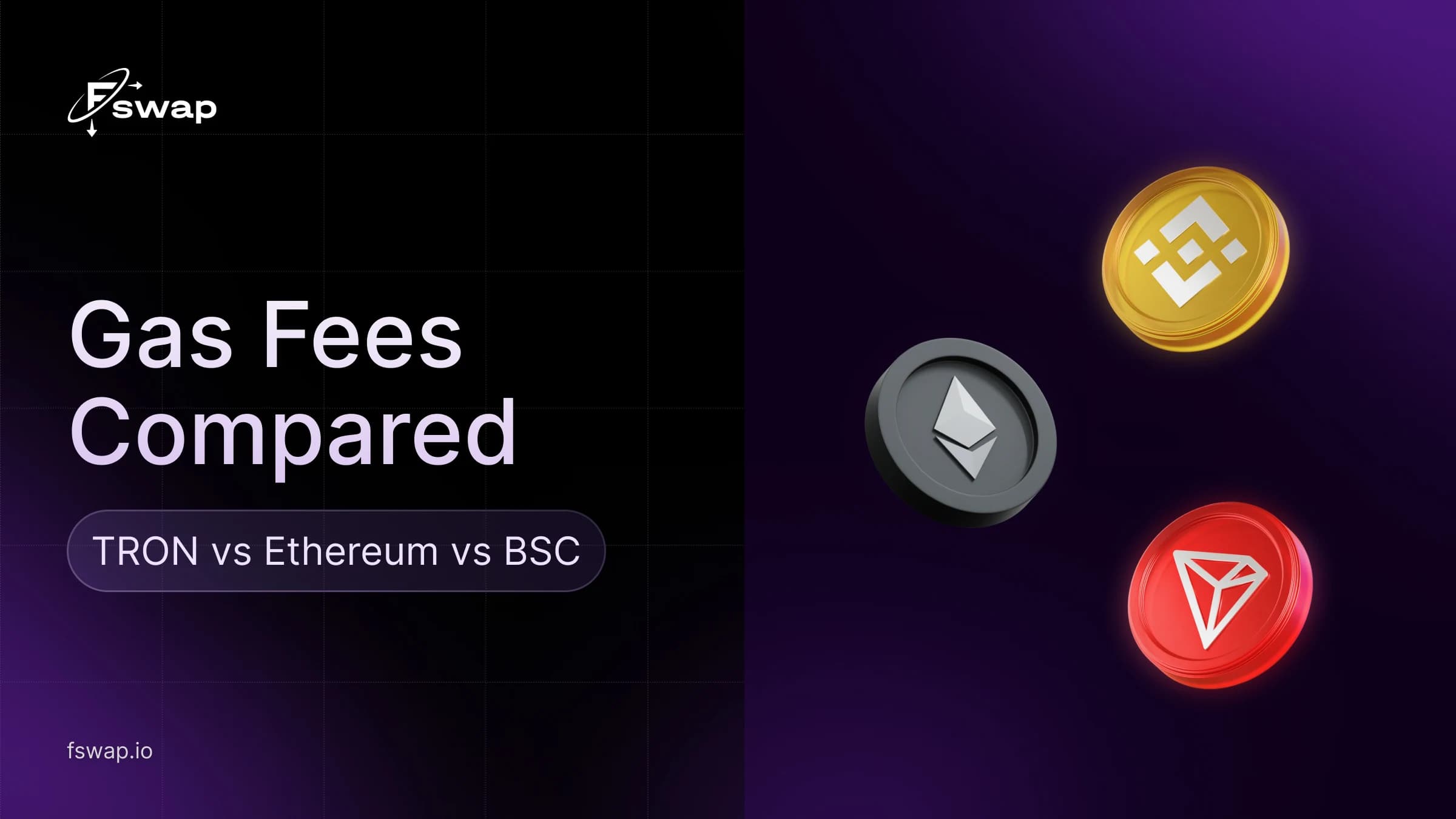
Send the same USDT on three different networks and you can pay a few cents, a couple of dollars, or more than the price of lunch, all for moving the exact same asset. That gap surprises people, and it's the single most avoidable cost in everyday crypto. This gas fees comparison breaks down what TRON, Ethereum, and BSC actually charge, why the numbers differ so much, and how to choose the cheapest network for what you're doing.
What a "gas fee" actually is
A gas fee is what you pay the network to process your transaction. It compensates the validators or miners who confirm transfers and keep the chain secure. The key thing to understand is that the fee has almost nothing to do with the amount you're sending. Moving $10 or $10,000 of USDT costs roughly the same in gas, because you're paying for computation and block space, not a percentage of the transfer. What changes the cost is which network you use, and how busy it is.
Ethereum (ERC-20): the most expensive by design
Ethereum uses an auction-style gas market. When you send a transaction, you're effectively bidding for space in the next block, and the price is set by ETH paid per unit of gas. When demand is high, that price climbs, and a simple USDT transfer that costs a dollar or two in a quiet window can spike to well over ten dollars, occasionally far more, during heavy congestion.
None of this means Ethereum is "bad." It's the original home of USDT and the network institutions trust for large settlements, where paying a few dollars on a six-figure transfer is trivial and the deep security is worth it. For small, everyday transfers, though, ERC-20 is usually the wrong tool. The mechanics of ERC-20 versus cheaper chains are worth understanding in full, which is why our guide to TRC-20 versus ERC-20 for USDT is a useful companion to this piece.
TRON (TRC-20): cheap and built for stablecoins
TRON took a different path. Instead of a pure auction, it uses a resource model based on energy and bandwidth, paid for in TRX. In practice, a casual user who lets the network burn TRX pays somewhere around one to five dollars per USDT transfer, while users who stake TRX to generate energy can bring the cost down to near zero. Blocks arrive every few seconds, and fees stay predictable even when volume surges.
This is why TRON carries a huge share of all USDT in circulation and processes millions of stablecoin transfers a day. It's the default rail for moving Tether between exchanges and to other people. If your goal is reliable, low-cost stablecoin movement, TRC-20 is hard to beat.
BSC (BEP-20): usually the cheapest of the three
BNB Chain, formerly Binance Smart Chain, is EVM-compatible and runs on a proof-of-staked-authority model with fast blocks. Gas is paid in BNB, and the cost of a standard USDT transfer is typically just a few cents, rarely climbing above a dollar. For pure per-transfer price among these three, BEP-20 usually wins.
The trade-off is ecosystem fit rather than cost. BEP-20 shines for moving funds in and out of the Binance ecosystem and adjacent apps, and because BNB itself powers the network's fees and a recurring token burn, it behaves a little differently from a plain gas token. If you're new to it, our overview of what BNB is and how BNB Chain works explains the mechanics behind those low fees.
Side by side: the short version
For a standard USDT transfer under normal conditions in 2026, the pattern is consistent:
- BSC (BEP-20): usually a few cents. Lowest per-transfer cost, best for the Binance ecosystem.
- TRON (TRC-20): roughly $1–5, or near-zero with staked energy. Deepest stablecoin liquidity, the default for exchange transfers.
- Ethereum (ERC-20): usually several dollars, and much higher when congested. Best reserved for large or institutional settlements.
Treat these as approximate. Gas is volatile, and the dollar cost also shifts with the price of ETH, TRX, and BNB, so it's worth checking current conditions before a large transfer.
One critical warning: the networks aren't interchangeable
USDT on Ethereum, TRON, and BSC are separate tokens on separate chains. Sending TRC-20 USDT to a BEP-20 or ERC-20 address, or vice versa, can mean permanent loss, because the receiving wallet may have no way to control the funds on the wrong chain. Always confirm that the network you're sending on matches the network your recipient expects. A moment of checking here prevents the most expensive mistake in this entire topic.
How to pay less, in practice
Choosing the network is the biggest lever, and simply moving an everyday transfer off Ethereum onto TRON or BSC removes most of the cost. Timing helps too, since Ethereum gas is often cheaper during quiet weekend hours. If you use TRON heavily, staking TRX for energy turns per-transfer fees into near-zero. And when you're converting between assets, a swap that supports multiple networks lets you receive directly on the cheap chain instead of paying to bridge afterward. On Fswap, you choose which network to receive your USDT on, so you can route into TRC-20 or BEP-20 and skip the Ethereum toll entirely.
Fees add up fastest for anyone moving funds frequently. If you're constantly repositioning capital, say to fund an active strategy like perpetual futures, the difference between a cent and several dollars per transfer compounds into real money over a month.
The takeaway
The cheapest network is usually BSC, TRON is the reliable stablecoin workhorse, and Ethereum is best kept for large settlements where its security earns the premium. Match the chain to the job, verify the network before every send, and use a swap like Fswap to land your funds on the low-fee network from the start. Do that, and gas stops being a mystery tax and becomes a choice you control.
FAQ
Which network has the cheapest gas fees for USDT?
Among these three, BSC (BEP-20) is usually the cheapest, with a standard transfer often costing just a few cents. TRON (TRC-20) is next and can be near-zero if you stake TRX for energy, while Ethereum (ERC-20) is typically the most expensive. Outside these three, some high-throughput chains are cheaper still, but for USDT specifically, BSC and TRON cover most everyday needs at very low cost.
Why are Ethereum gas fees so high?
Ethereum prices transactions through an auction-style gas market, so you're bidding for limited block space and paying in ETH. When the network is busy, that price rises sharply, which is why a transfer can cost a dollar in a quiet period and much more during congestion. The fee reflects demand for block space, not the size of your transfer, so timing and network choice matter more than the amount you send.
Are TRC-20, ERC-20, and BEP-20 USDT the same thing?
No. They're the same stablecoin issued separately on three different networks, and they are not interchangeable. Sending USDT on one network to an address on another can result in permanent loss, since the receiving wallet may not control funds on the wrong chain. Always match the sending network to the one your recipient's wallet or exchange actually supports before you confirm.
How can I reduce the gas fees I pay?
The most effective step is choosing a cheaper network, moving everyday USDT transfers off Ethereum onto TRON or BSC. On Ethereum, sending during off-peak hours helps, and on TRON, staking TRX for energy can cut per-transfer costs to almost nothing. When swapping assets, picking a service that lets you receive on the network you want means you land on the low-fee chain directly, rather than paying again to move afterward.
其他文章