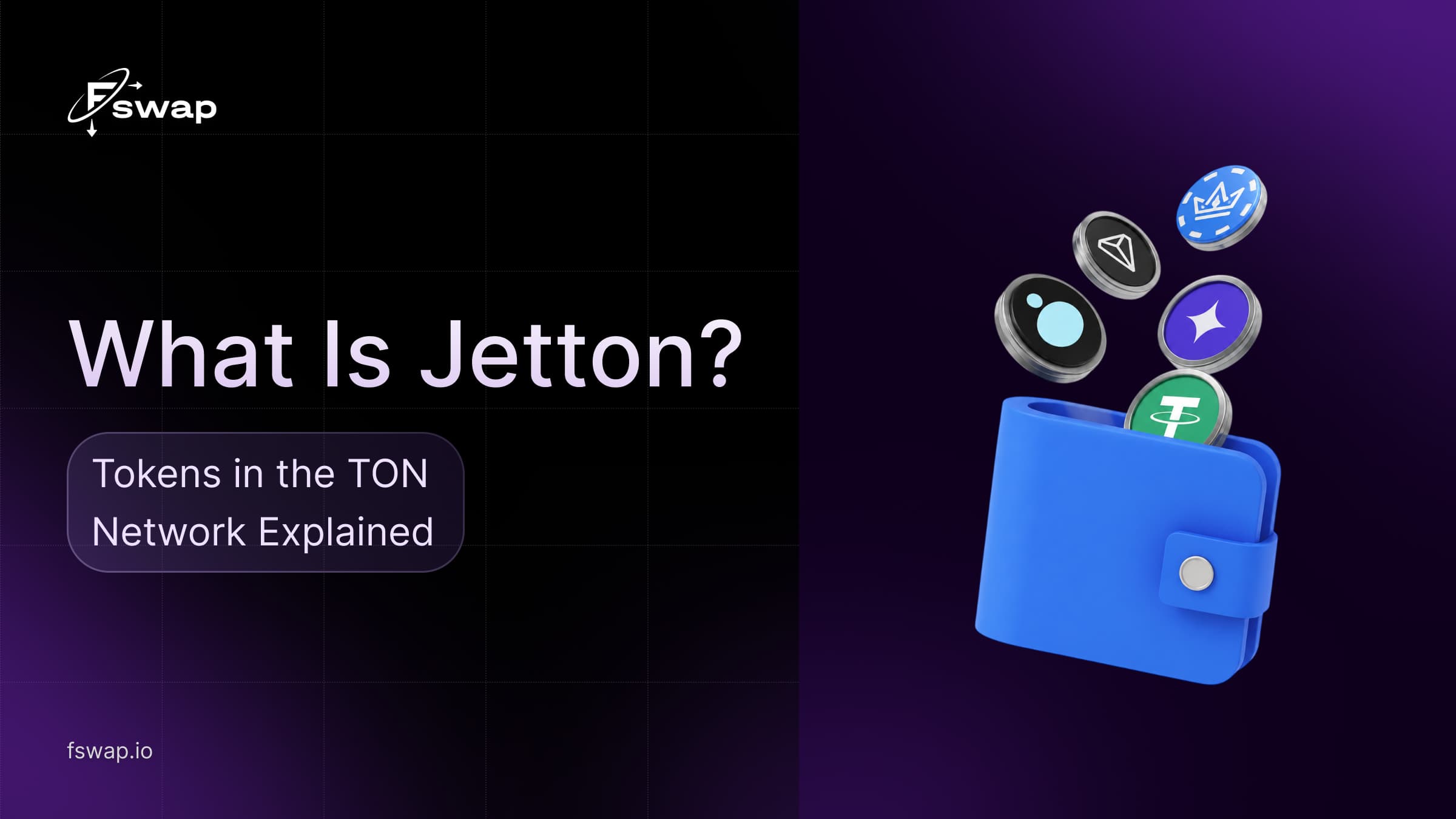
What Is Jetton? Tokens in the TON Network Explained
If you've ever received USDT inside Telegram, tapped your way through a game like Notcoin or Hamster Kombat, or held tokens like DOGS, you've already used a Jetton — probably without knowing it. Jettons are the token standard that powers almost everything that isn't the native coin on The Open Network (TON), the blockchain originally built by Telegram's team. They serve the same purpose as ERC-20 tokens on Ethereum, but the way they're built underneath is genuinely different — and that difference shapes how fees work, why transfers behave the way they do, and what you need to watch out for.
This guide explains what a Jetton actually is, how its unusual two-contract architecture works, why you always need a little TON on hand, and how Jettons compare to the token standards you might already know.
What Is a Jetton?
What does "Jetton" actually mean? A Jetton is the standard for fungible tokens on the TON blockchain — the equivalent of ERC-20 on Ethereum or TRC-20 on Tron. "Fungible" means every unit is identical and interchangeable: one unit of a given Jetton is always worth exactly the same as any other unit of that same Jetton, just like one dollar equals any other dollar. The standard is formally defined as TEP-74 (with TEP-89 covering metadata like the token's name, symbol, and image).
The distinction that trips up newcomers is the difference between a coin and a token. Toncoin (TON) is the network's native coin — it's built into the blockchain itself and is used to pay transaction fees. A Jetton is a token that runs on top of TON via smart contracts. This is the same coin-versus-token relationship that exists on other chains, and it's worth understanding clearly because it explains why you always need some TON even when you're only moving a Jetton. That native-coin-for-gas relationship is covered more generally in this explainer on how token swaps and gas fees work.
The Key Difference: How Jettons Are Built
How is a Jetton different from an ERC-20 token? This is where TON's design really stands apart. On Ethereum, a single ERC-20 smart contract stores every holder's balance in one central ledger — one contract knows how much everybody owns. Jettons take the opposite approach: they split the design across two types of contracts.
- The Jetton master contract is the token's "source of truth." It defines the token — its name, symbol, decimals, total supply, and metadata — and it mints new tokens when needed. Crucially, the master contract does not hold anyone's balance. It only coordinates and provides information. Its address is the one thing that uniquely identifies a genuine Jetton.
- Jetton wallet contracts hold the actual balances — but there's a separate one for each user, per token. When you receive a particular Jetton for the first time, a personal Jetton wallet contract is automatically deployed for you. Your wallet address for that token is calculated deterministically from your main TON address plus the master contract address.
So instead of one giant contract tracking millions of balances, TON spreads those balances across millions of individual wallet contracts that talk to each other by passing messages. This is called a sharded or distributed design, and it's a deliberate feature, not a quirk: it lets the network scale without creating a single global bottleneck where every transaction has to queue through the same contract.
How a Jetton Transfer Actually Works
What happens when you send a Jetton? Unlike a simple value transfer, sending a Jetton is a small choreography of on-chain messages between contracts. The simplified sequence looks like this:
- Your main TON wallet sends a message to your Jetton wallet contract, instructing it to transfer.
- Your Jetton wallet contract deducts the amount and sends an internal message to the recipient's Jetton wallet contract.
- The recipient's Jetton wallet contract increases its balance and sends a notification to the recipient's main TON address.
- Any leftover TON used for gas is returned to the sender as an "excess" message.
A single Jetton transfer therefore involves several coordinated on-chain messages — a consequence of TON's asynchronous execution model, where contracts communicate by passing messages rather than calling each other directly and instantly. In practice this all happens in seconds and costs a fraction of a TON, so you rarely notice the complexity. But it's the reason the next point matters so much.
Why You Always Need TON for Gas
Can you send a Jetton without holding any TON? No — and this is the single most common mistake new TON users make. Even when you're sending USDT, NOT, or any other Jetton, the network fee is always paid in Toncoin, not in the Jetton itself. A typical transfer costs a small amount of TON (often around 0.05–0.1 TON, with any excess returned), but without some TON in your wallet, the transfer simply cannot be broadcast.
The practical rule: always keep a small TON buffer in any wallet you use for Jettons. If you hold only USDT on TON and no Toncoin, you'll be stuck — unable to move your own funds until you get a little TON in. This is different from the mental model many people bring from centralized exchanges, where fees are quietly deducted from whatever you're sending.
The Jetton Ecosystem: What's Actually Built on It
By 2026, Jettons have grown into a serious token economy spanning stablecoins, viral games, and DeFi. The major categories include:
- Stablecoins. USDT on TON — native USDT issued directly by Tether as a Jetton — is the largest Jetton by supply and has become a genuine payment rail, partly because Telegram's built-in wallet makes it easy for hundreds of millions of users to send and receive without installing anything separate.
- Tap-to-earn game tokens. NOT (Notcoin), HMSTR (Hamster Kombat), DOGS, and other viral Telegram airdrop tokens are all Jettons. These "tap-to-earn" games drove much of TON's mainstream user growth.
- DeFi tokens. Tokens for TON-native decentralized exchanges like STON.fi and DeDust, plus liquid-staking tokens (such as tsTON or stTON) and LP tokens representing DeFi positions, are all built on the Jetton standard.
One important caveat: because USDT-TON is a separate Jetton from USDT on Ethereum (ERC-20) or Tron (TRC-20), the different versions are not directly interchangeable. Moving USDT between these networks requires bridging or routing through a service that supports both. Choosing the wrong network when withdrawing — sending USDT-TON to an address expecting USDT-TRC20, for example — is one of the most common ways people lose funds, so always verify the network on both sides before confirming.
Jetton vs ERC-20 vs TRC-20: Quick Comparison
All three standards solve the same problem — representing fungible tokens on a blockchain — but with different mechanics:
- Balance storage. ERC-20 and TRC-20 keep all balances in one central contract. Jettons distribute balances across per-user wallet contracts.
- Gas token. ERC-20 fees are paid in ETH, TRC-20 in TRX (or via energy/bandwidth), and Jetton fees in TON. In all cases you need the native coin, not the token, to move funds.
- Execution model. Ethereum and Tron execute transactions synchronously; TON is asynchronous, with contracts passing messages, which is why a Jetton transfer involves multiple on-chain messages.
- Scaling philosophy. The distributed Jetton design is built to scale with network load rather than funneling everything through one contract — a trade-off that adds transfer complexity in exchange for throughput.
Staying Safe with Jettons
How do you avoid fake Jettons? Because anyone can create a Jetton, scam tokens that copy the name, symbol, and logo of a legitimate project are common. The only thing that uniquely and reliably identifies a real Jetton is its master contract address — not its name or ticker, both of which can be freely duplicated. Before trading or adding an unfamiliar Jetton, verify its master contract address against the project's official website or a trusted explorer.
The other risk vector isn't the token itself but the social layer around it. Fake "TON support" accounts, cloned wallet sites, and unsolicited messages offering airdrops or "help" follow the same playbook used across all of crypto. The verification habits laid out in this checklist for spotting fake crypto exchanges and scam contacts in Telegram apply directly here — especially relevant given that TON lives inside Telegram, where these scams are most active. The core rules: verify contract addresses independently, never trust a link or DM sent to you first, and remember that legitimate services don't message you out of nowhere.
How to Get and Swap Jettons
Where do you get Jettons? The most common routes are buying directly through a TON wallet's built-in on-ramp (like Tonkeeper or Telegram's @wallet), swapping into them on TON-native DEXs like STON.fi or DeDust, or withdrawing them from a centralized exchange that supports the TON network. If you're new to crypto entirely and starting from fiat, the options and trade-offs for that first purchase are covered in this guide to on-ramp providers and KYC requirements.
If you already hold crypto on another chain and want to move into a Jetton — say, converting BTC or ETH into TON or USDT-TON — a non-custodial swap service handles the cross-chain step without requiring you to open an exchange account. A crypto-to-crypto platform like Fswap lets you swap directly from your own wallet into TON-network assets, which you can then use across the Jetton ecosystem — just remember to keep a little TON aside for gas once your funds arrive.
FAQ
What is a Jetton in the TON network?
A Jetton is the standard for fungible tokens on the TON blockchain, defined by the TEP-74 standard. It's TON's equivalent of Ethereum's ERC-20, letting projects issue custom tokens — stablecoins, game tokens, DeFi tokens — that TON wallets and apps can recognize and handle.
What's the difference between TON and a Jetton?
Toncoin (TON) is the network's native coin, built into the blockchain and used to pay transaction fees. A Jetton is a token that runs on top of TON through smart contracts. You always need some TON to move a Jetton, because gas fees are paid in TON, not in the Jetton itself.
Why do I need TON to send USDT on TON?
Because all Jetton transfers — including USDT-TON — pay their network fee in Toncoin, not in the token being sent. Without a small amount of TON in your wallet, the transfer can't be broadcast to the network. Always keep a little TON as a gas buffer.
How are Jettons different from ERC-20 tokens?
ERC-20 stores all balances in a single central contract. Jettons split the design into one master contract (defining the token) and many individual wallet contracts (one per user, holding balances). This distributed design helps TON scale, but means a single transfer involves several on-chain messages between contracts.
Is USDT on TON the same as USDT on Ethereum or Tron?
No. USDT-TON is a separate Jetton, tracked independently from USDT on Ethereum (ERC-20) or Tron (TRC-20). They target the same dollar peg but aren't directly interchangeable — moving between networks requires bridging or an exchange that supports both. Sending to the wrong network is a common way to lose funds.
How do I know if a Jetton is real and not a scam?
Verify the Jetton's master contract address against the project's official website or a trusted block explorer. The name, symbol, and logo can all be freely copied by scammers — only the master contract address uniquely identifies a genuine Jetton.
Conclusion
Jettons are TON's take on the fungible token — familiar in purpose, but built on a distributed master-and-wallet architecture that trades a little transfer complexity for the ability to scale. For everyday users, most of that complexity stays invisible: you send a token, it arrives in seconds, and it costs a fraction of a TON. The two things worth remembering are practical, not technical — always keep a small TON balance for gas, and always verify a Jetton's master contract address before trusting it.
With USDT, the biggest tap-to-earn game tokens, and a growing DeFi ecosystem all running as Jettons, the standard has quietly become one of the most-used token formats in crypto — largely because it lives where hundreds of millions of people already are: inside Telegram.
This article is educational content, not financial advice. Always do your own research and verify contract addresses before interacting with any token.
Andere Artikel