Network Confirmations: Why Your Swap Is Pending
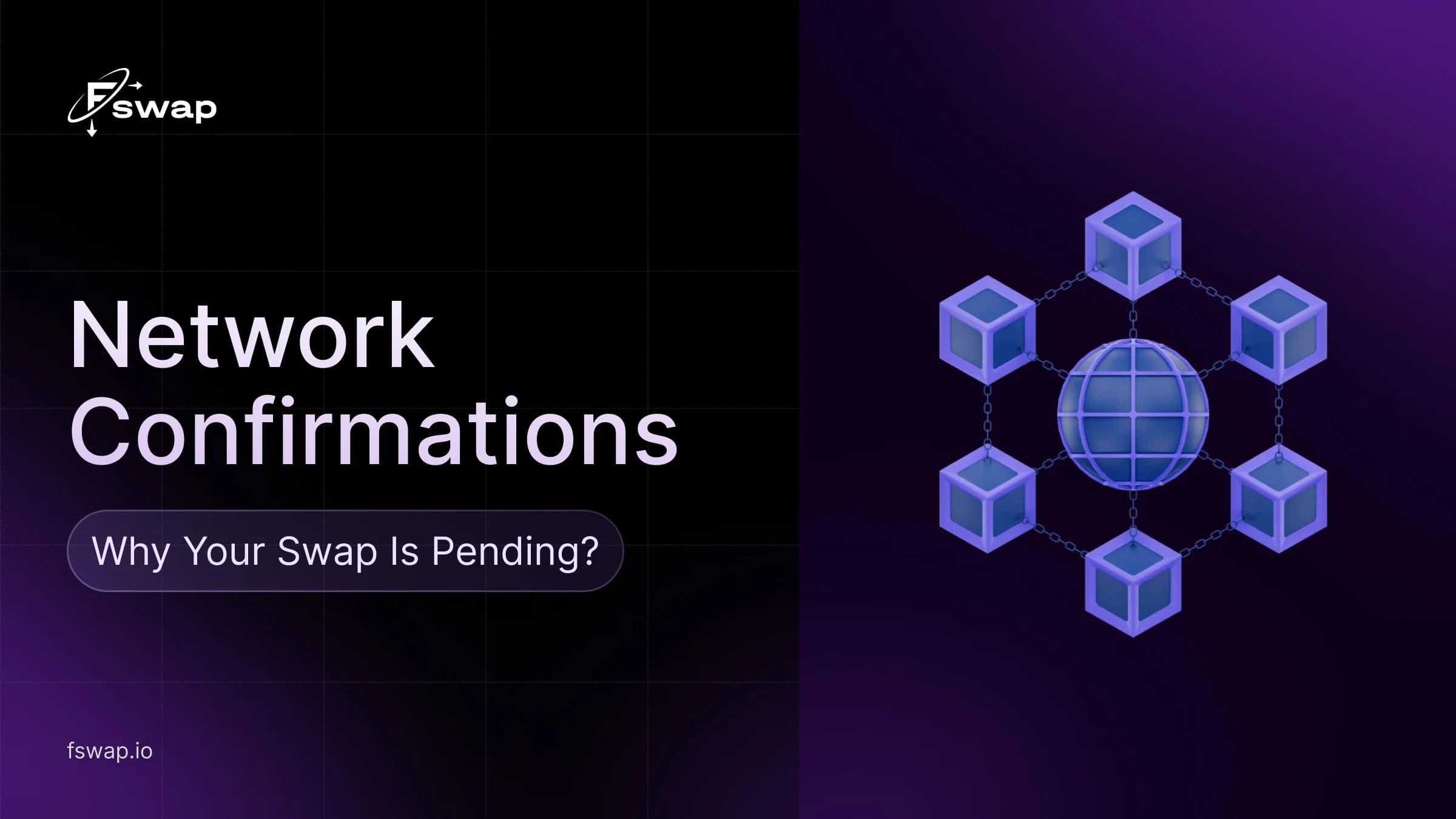
You sent your crypto, the swap page says "pending," and nothing seems to be happening. It's one of the most common moments of doubt in crypto, and almost always a normal part of how blockchains work rather than a sign that anything went wrong. Understanding network confirmations turns that anxious wait into a predictable, explainable process.
This guide breaks down what "pending" actually means, why a swap waits for confirmations, and what does (and doesn't) affect how long it takes.
What "pending" really means
When you send a transaction, it doesn't hit the blockchain instantly. It first enters a waiting area called the mempool, where it sits alongside every other unconfirmed transaction until a miner or validator picks it up and includes it in a block. Until that happens, your transfer is broadcast but not yet recorded, which is exactly the state a crypto pending transaction describes.
A swap shows "pending" because it's waiting on this process at least once, and often twice: once for your deposit to be confirmed on the source network, and again for the payout to confirm on the destination network. Nothing is lost during this window; the funds are simply in transit.
How confirmations work
A confirmation is what you get when your transaction is included in a block. That first block is one confirmation. Each new block added on top of it counts as another, because it makes your transaction progressively harder to reverse. This is why people talk about waiting for a certain number of confirmations rather than just one.
The reason is security. Requiring several confirmations protects against rare events like chain reorganizations or double-spend attempts, where a very recent block could theoretically be replaced. After enough blocks stack on top, that possibility effectively disappears, and the transaction is treated as settled. So the wait isn't wasted time; it's the network making your swap final.
Why different networks take different times
Confirmation times vary a lot between networks, and that's by design. Bitcoin produces a block roughly every ten minutes and services often wait for a few confirmations, so a BTC deposit can take a while. Faster networks confirm in seconds. This is one practical reason the network you choose matters, and it's part of why our breakdown of TRC-20 versus ERC-20 for USDT is worth a read before you pick a chain, since fees and speed differ sharply between them.
The number of confirmations a service requires also differs by asset. A higher-value or slower network may ask for more confirmations to stay safe, while a fast, low-fee network may need fewer. Neither is better in the abstract; they reflect each network's security and block schedule.
What actually affects your wait
A few factors decide how long "pending" lasts, and most come down to fees and timing.
The biggest is the fee you paid. Miners and validators prioritize transactions that pay more, so a low fee during a busy period can leave your transaction sitting in the mempool longer. Network congestion amplifies this: when demand spikes, the queue grows and everyone waits. Block time sets the floor, since even a well-paid transaction can't confirm faster than the network produces blocks. And on some networks, a missing deposit comment or memo can hold up crediting even after the transaction confirms, which is one of the quirks we cover in our guide to how Jettons work on TON.
When a swap is genuinely stuck
Most "pending" swaps aren't stuck; they're just waiting. A transaction is only genuinely delayed when it stays unconfirmed in the mempool for an unusually long time, typically because the fee was too low to get picked up. Even then it usually resolves on its own: it either confirms once congestion clears or drops out of the mempool so the funds return to a spendable state, depending on the network.
What helps most is having the right information ready. Your transaction hash lets you track progress on a block explorer and see exactly how many confirmations you have. If a deposit has confirmed on-chain but a swap still hasn't credited, that hash and your order ID are what let support locate it quickly.
How a swap service handles this for you
A non-custodial swap watches both sides of the transfer so you don't have to. On Fswap, the swap waits for your deposit to reach the required confirmations, then routes the payout to your destination wallet automatically. You can follow the status the whole time, and because funds move directly between wallets, there's no account balance sitting in limbo. The "pending" state is simply the network doing its job before the payout is released.
The takeaway
A pending swap is usually the system working correctly, not failing. Your transaction is moving through the mempool, into a block, and toward the confirmations that make it final. Pay a reasonable fee, choose a network that fits your need for speed, keep your transaction hash handy, and the wait becomes exactly what it should be: brief, predictable, and nothing to worry about. When you're ready to swap again, Fswap handles the confirmation logic for you.
FAQ
Why is my crypto transaction still pending?
It's waiting to be confirmed. Your transaction sits in the mempool until a miner or validator includes it in a block, and then it needs a set number of confirmations before it's considered final. The most common reasons for a longer wait are a low fee or network congestion, both of which push your transaction further back in the queue. In most cases it clears on its own once a block picks it up.
How many confirmations does a swap need?
It depends on the network and the asset. Slower or higher-value networks tend to require more confirmations for safety, while fast, low-fee networks often need fewer. There's no single universal number, so the requirement is set to match each network's block schedule and security. Once your deposit hits the required count, the swap can move to its payout stage.
Can I speed up a pending transaction?
Sometimes, depending on the wallet and network. Some wallets support fee-bumping methods that raise the fee on a stuck transaction so it's picked up sooner. Beyond that, you generally can't force the network to go faster, since block times are fixed. The most reliable approach is to set an appropriate fee when you send, especially during busy periods, rather than trying to fix it afterward.
Is my money safe while a swap is pending?
Yes. A pending transaction is broadcast to the network but not yet finalized, and the funds are in transit rather than lost. On a non-custodial swap, coins move directly between wallets, so nothing is being held in an account you can't access. Keep your transaction hash and order ID so you can track progress on a block explorer or check with support if a confirmed deposit hasn't credited yet.
مقالات اخرى